
KEY HIGHLIGHTS
- Comprehensive coverage and live status updates on History of Independence Day: How India Won Freedom From British Rule.
- Key statements from government officials and field correspondents.
- Historical context and market/social impact analysis.
- Read full detailed breakdown below.
History of Independence Day: India celebrates Independence Day every year on August 15 to commemorate the country's freedom from British colonial rule in 1947. The day is a reminder of the long and difficult struggle for independence, in which millions of Indians participated and countless freedom fighters made sacrifices for the nation.
The journey to independence was not achieved overnight. It was the result of decades of protests, movements, political campaigns, revolutionary activities and sacrifices that eventually ended nearly 200 years of British rule.
Beginning of British Rule in India
The roots of British political control in India can be traced to the East India Company. After the Battle of Plassey in 1757, the company gradually expanded its influence over large parts of the country.
Following the Indian Rebellion of 1857, the British Crown took direct control of India in 1858. India remained under British rule for almost nine more decades.
During this period, Indians increasingly began demanding greater political representation, economic rights and eventually complete independence.
Rise of the Indian Freedom Movement
The formation of the Indian National Congress in 1885 marked an important development in India's political history. Initially, Congress leaders sought greater participation of Indians in administration and constitutional reforms.
Over time, the demand became stronger. Leaders such as Bal Gangadhar Tilak, Lala Lajpat Rai and Bipin Chandra Pal helped popularise nationalist ideas and encouraged people to participate in the freedom movement.
The partition of Bengal in 1905 also triggered widespread protests and strengthened the Swadeshi movement, encouraging Indians to boycott British goods and support locally produced products.
Mahatma Gandhi and the Non-Violent Struggle
The freedom movement gained a new direction after Mahatma Gandhi returned to India from South Africa in 1915. Gandhi promoted non-violent resistance and encouraged ordinary citizens to participate in the struggle against British rule.
Several major movements were launched under his leadership, including the Non-Cooperation Movement, Civil Disobedience Movement and Quit India Movement.
The Salt March of 1930 became one of the most famous examples of civil disobedience. Gandhi and his followers challenged the British salt laws and demonstrated the power of peaceful mass mobilisation.
Role of Revolutionaries and Other Leaders
India's independence movement included many different approaches and leaders. Revolutionaries such as Bhagat Singh, Chandrashekhar Azad, Ram Prasad Bismil and Ashfaqulla Khan fought against British rule and inspired young Indians with their courage and sacrifice.
Subhas Chandra Bose also played a significant role through the Indian National Army, popularly known as the INA. His call of “Give me blood, and I will give you freedom” became one of the most memorable slogans of India's independence struggle.
Leaders such as Sardar Vallabhbhai Patel, Jawaharlal Nehru, Maulana Abul Kalam Azad and Sarojini Naidu also made significant contributions to the national movement.
Quit India Movement
One of the most important phases of the freedom struggle began in 1942, when Mahatma Gandhi launched the Quit India Movement.
The movement called for an immediate end to British rule. Despite widespread arrests and repression by the colonial government, the movement demonstrated the growing determination of Indians to achieve independence.
The Second World War also placed significant economic and political pressure on Britain, further changing the circumstances surrounding India's future.
India Moves Towards Independence
After the Second World War ended in 1945, it became increasingly difficult for Britain to maintain its colonial rule in India. Political negotiations intensified between British authorities and Indian leaders.
The Indian Independence Act 1947 was passed by the British Parliament, paving the way for the creation of two independent dominions—India and Pakistan.
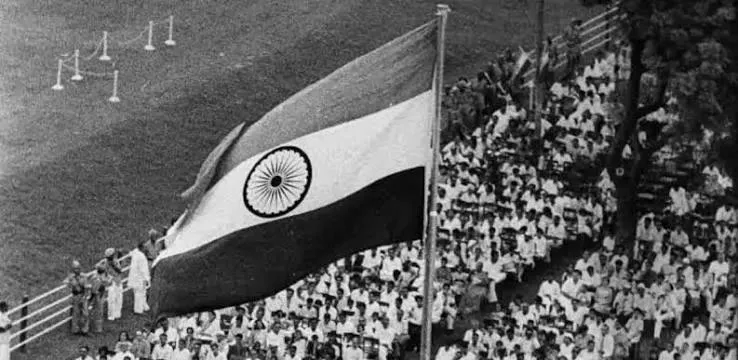
India finally became independent at midnight between August 14 and August 15, 1947.
Jawaharlal Nehru's Historic Speech
On the eve of independence, Jawaharlal Nehru delivered his famous “Tryst with Destiny” speech. He spoke about India's long-awaited freedom and the responsibilities that came with it.
On August 15, 1947, Nehru hoisted the Indian national flag at the Red Fort in Delhi, beginning a tradition that continues every Independence Day.
Why August 15 Is Celebrated
August 15 was selected as India's Independence Day because the British government transferred power to India on that date in 1947.
The day is observed every year to honour the sacrifices of freedom fighters and celebrate India's sovereignty. The Prime Minister traditionally hoists the national flag at the Red Fort and addresses the nation.
Schools, colleges, government institutions and communities across the country also organise flag-hoisting ceremonies, cultural programmes and patriotic events.
Independence Day After 1947
Since independence, India has continued to develop as a democratic republic. The Constitution of India came into effect on January 26, 1950, establishing India as a republic.
Independence Day continues to serve as a reminder of India's freedom struggle while encouraging citizens to contribute toward the country's progress.
Conclusion
The history of India's Independence Day is inseparable from the country's long freedom struggle. From the resistance against British expansion to the mass movements led by Mahatma Gandhi and the sacrifices of revolutionaries, India's independence was shaped by the efforts of people from different backgrounds.
August 15 is therefore not merely a national holiday. It is a day to remember the courage and sacrifices of those who fought for freedom and to reflect on the responsibility of building a stronger, peaceful and prosperous India.








Leave a Comment
Please sign in to join the conversation.
Sign In to CommentDon't have an account? Sign Up